
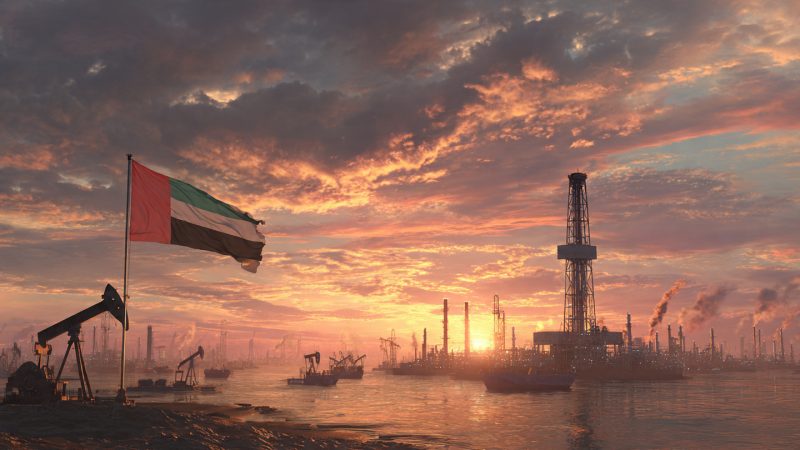
ABU DHABI / VIENNA – In a seismic shift that has sent tremors through global energy markets, the United Arab Emirates announced its withdrawal from OPEC and OPEC+ yesterday, dealing a potentially fatal blow to the oil cartel at the very moment when the US-Israel war on Iran has already triggered a historic energy shock.
The decision, effective Friday, was framed by Emirati authorities as a matter of national interest. But behind the diplomatic language lies a story of frayed Gulf alliances, soaring regional tensions, and a fundamental recalculation of oil power in a world where the Strait of Hormuz has become a battleground.
“During our time in the organisation, we made significant contributions and even greater sacrifices for the benefit of all,” a state media statement read. “However, the time has come to focus our efforts on what our national interest dictates.”
The Context: A Cartel Under Siege
OPEC has not lost a major member lightly. The UAE first joined through its emirate of Abu Dhabi in 1967, later becoming a founding member of the modern UAE in 1971. For nearly six decades, Abu Dhabi has been a reliable—if occasionally restless—pillar of the cartel.
But the current moment is unlike any other. The US-Israel war on Iran has turned the Strait of Hormuz—a narrow chokepoint through which one-fifth of the world’s crude oil and liquefied natural gas normally pass—into a shooting gallery. Threats and attacks against vessels have made shipping perilous, and Gulf producers are already struggling to get their exports out.
Into this chaos, the UAE has chosen to go its own way.
Why Now? Rivalry with Riyadh and Frustration with Quotas
Beneath the surface, analysts point to two primary drivers: deepening Saudi-Emirati competition and long-simmering frustration with OPEC’s quota system.
The UAE and Saudi Arabia have increasingly clashed over economic issues and regional politics, particularly in the Red Sea. The two were nominal allies in the coalition fighting Yemen’s Iran-backed Houthi rebels from 2015 onward. But that coalition collapsed in recriminations late last December, when Saudi Arabia bombed what it described as a weapons shipment bound for Yemeni separatists backed by the UAE.
The energy front tells a similar story. The UAE has invested heavily in raising its production capacity to 4.8 million barrels per day—and it wants to use that capacity. But OPEC’s quota system, long dominated by Saudi Arabia, has forced producers to limit output to manage prices.
“With demand nearing a peak, the calculation for producers with low-cost barrels is changing fast,” said Jorge Leon, head of geopolitical analysis at Rystad Energy. “Waiting your turn inside a quota system starts to look like leaving money on the table.”
Energy Minister Suhail Mohamed al-Mazrouei was careful to say the decision was made without consulting any other country—including Saudi Arabia. “This is a policy decision. It has been done after a careful look at current and future policies related to level of production,” he told Reuters.
Global Repercussions: A Market Loses Its Shock Absorber
The immediate impact is stark. OPEC loses a member with nearly 5 million barrels per day of capacity and the ambition to produce more. That is not merely a statistical loss; it is the removal of one of the cartel’s most significant tools for influencing global prices.
“Saudi Arabia is now left doing more of the heavy lifting on price stability,” Leon warned. “The market loses one of the few shock absorbers it had left.”
That is a perilous situation. The war on Iran has already caused energy prices to spike, rattling the global economy. Without the UAE as a partner in coordinated production management, Saudi Arabia may find itself unable to stabilise prices—or unwilling to carry the burden alone.
For consumers, the likely outcome is higher and more volatile prices. For producers outside OPEC, particularly the United States—which has dramatically increased its own crude production in recent years—the UAE’s departure could be an opportunity to capture market share.
Trump’s Shadow: “Ripping Off the Rest of the World”
President Donald Trump has long been a vocal critic of OPEC, accusing the cartel of “ripping off the rest of the world” by inflating oil prices. He has also linked US military support for Gulf states with oil prices, arguing that while America defends OPEC members, they “exploit this by imposing high oil prices.”
The UAE’s departure does not directly address Trump’s complaints. But it does fragment the organisation he loves to criticise, potentially giving Washington more leverage to strike separate energy deals with individual Gulf producers. Whether that was a factor in Abu Dhabi’s calculation—or whether Trump will celebrate the move as a victory—remains to be seen.
REACTIONS: Riyadh, Washington, Moscow, and the Markets Respond
Saudi Arabia: Public Silence, Private Fury
Riyadh has offered no official comment beyond a terse acknowledgment of the UAE’s announcement. But diplomats and energy analysts describe a climate of profound frustration behind palace doors.
“The Saudis were blindsided,” a Gulf diplomatic source told The Prospera Report, speaking on condition of anonymity. “This was not discussed at any OPEC meeting. The UAE simply decided and informed everyone afterward. That is not how allies behave.”
The Saudi-Emirati rivalry has deepened over the past year, with disagreements over Yemen, investment projects, and now energy policy. Some analysts see the UAE’s exit as a direct challenge to Saudi leadership of the Arab Gulf—a leadership Riyadh has historically taken for granted.
Prince Abdulaziz bin Salman, Saudi Arabia’s energy minister, has not yet spoken publicly. But those familiar with his thinking say he views OPEC+ as a critical instrument of Saudi influence. Losing the UAE—one of the few members with significant spare capacity—weakens that instrument considerably.
The Saudi stock market fell 2.3 percent in early trading following the announcement, though it recovered some losses by the close.
United States: Cautious Welcome, Strategic Calculation
The Trump administration responded with measured optimism. White House Press Secretary Karoline Leavitt said in a statement: “President Trump has long argued that OPEC’s market manipulation harms American families. We are monitoring the situation closely and will continue to work with our Gulf partners to ensure stable and affordable energy supplies.”
Energy Secretary Dan Brouillette went further in a private briefing with industry executives, portions of which were leaked to Reuters. “A fragmented OPEC is a weaker OPEC,” Brouillette reportedly said. “And a weaker OPEC means the market, not a cartel, sets the price of oil.”
Some US lawmakers welcomed the development. Senator Bill Cassidy (R-La.), whose state is a major energy producer, said: “The UAE should be free to produce as much oil as it wants. OPEC quotas have artificially restricted supply for decades. This is a step toward a freer market.”
But others expressed concern about volatility. Senator Jack Reed (D-R.I.) warned: “In the middle of a war with Iran, the last thing the global economy needs is uncertainty over oil supply. The administration needs to be prepared for price spikes.”
Iran: Mockery and Warning
Iranian state media seized on the announcement as evidence of disarray among Gulf Arab states. “The American-backed oil cartel is crumbling,” declared a commentary on Press TV. “The so-called ‘moderate’ Gulf states cannot even agree among themselves. This is what happens when you follow Washington’s orders.”
More ominously, Iran’s Islamic Revolutionary Guard Corps (IRGC) issued a statement warning that any attempt by the UAE to ramp up oil exports through the Strait of Hormuz would be met with “appropriate measures.” The strait remains the single most vulnerable chokepoint for Gulf oil, and Iran has repeatedly threatened to close it.
“The UAE may have left OPEC,” an IRGC commander told semi-official Fars News Agency, “but it cannot leave geography. The strait is under our control.”
Russia: Opportunistic Silence
Moscow, which has coordinated closely with Saudi Arabia within the OPEC+ framework, offered no immediate public response. But analysts expect the Kremlin to view the UAE’s departure as a mixed blessing.
On one hand, a weaker OPEC means less coordinated action to raise prices—which benefits Russian oil revenues in the short term, as Russia is not bound by OPEC quotas. On the other hand, if prices become too volatile or collapse due to oversupply, Russian finances would suffer.
“Russia will wait and watch,” said Alexander Novak, former Russian energy minister and key OPEC+ negotiator, in comments to TASS. “The framework remains. One member leaving does not destroy the entire architecture.”
But privately, Russian oil executives are said to be concerned. The UAE was a reliable partner within OPEC+. Its exit could encourage other members—Iraq, Libya, or even Nigeria—to reconsider their commitments.
European Union: Alarm Over Energy Security
European capitals, already reeling from high energy prices exacerbated by the Iran war, reacted with alarm. EU Energy Commissioner Kadri Simson issued a statement calling for “restraint and coordination among all oil-producing nations.”
“Energy prices are already at painful levels for European households and businesses,” Simson said. “Any additional disruption or uncertainty will be deeply damaging. We urge all parties to avoid unilateral actions that could further destabilise global markets.”
Germany’s economy ministry reportedly convened an emergency meeting of its energy crisis task force. France called for an extraordinary meeting of the International Energy Agency (IEA). Italy, heavily dependent on imported oil, began activating contingency plans.
China: Strategic Patience
Beijing’s response was characteristically cautious. Foreign Ministry spokesperson Wang Wenbin said China “respects the sovereign decisions of all countries” and called on “all producing nations to work together to ensure stable energy markets.”
But behind the diplomatic language, Chinese officials are deeply concerned. China is the world’s largest oil importer, and any sustained price spike would damage its post-pandemic recovery. Beijing has maintained good relations with both Saudi Arabia and the UAE, and is now quietly reaching out to both to ensure continued supply.
State-owned oil giant Sinopec has reportedly accelerated negotiations with the UAE’s ADNOC for long-term supply contracts, hoping to lock in volumes before global markets adjust to the new reality.
India: Vulnerability and Hedging
India, the world’s third-largest oil importer, finds itself in an exposed position. It has traditionally balanced its energy purchases between Russia, the Gulf, and other producers. The UAE is a particularly important partner—India’s fourth-largest crude supplier.
“We are in contact with all our traditional suppliers,” an Indian oil ministry official told Reuters, speaking on condition of anonymity. “The UAE has assured us that its production and export commitments will continue uninterrupted. But we are also exploring all options, including increased purchases from Russia and the US.”
Oil Markets: Immediate Jitters, Longer Uncertainty
The immediate market reaction was sharp but not catastrophic. Brent crude, the international benchmark, spiked 4.2 percent on the announcement before settling 2.1 percent higher by end of trading. WTI, the US benchmark, rose 1.8 percent.
Analysts attributed the muted response to two factors. First, the market had already priced in significant supply disruptions due to the Hormuz situation. Second, traders are waiting to see whether the UAE’s exit leads to a genuine production surge or remains largely symbolic.
“The next 30 days are critical,” said Helima Croft, head of global commodity strategy at RBC Capital Markets. “If the UAE announces a significant production increase, prices could soften. If instead this is just a political statement with no supply response, the impact will be limited.”
The bigger concern is long-term. OPEC has lost a major member before—Indonesia, Qatar, and Ecuador have all left at various points. But none of those exits came during a major war or with global energy markets this tight.
“Saudi Arabia is now the only Gulf producer with significant spare capacity,” Croft added. “That gives Riyadh enormous power, but also enormous vulnerability. One accident, one attack, one miscalculation—and there is no one else to share the burden.”
Analysis: What the UAE’s Exit Means for the Gulf Order
The UAE’s decision is not merely an energy story. It is a geopolitical earthquake.
For decades, the Gulf Arab monarchies have presented a united front to the world—through OPEC, through the Gulf Cooperation Council (GCC), and through joint security arrangements. That unity has frayed before, but rarely so publicly.
The Saudi-Emirati rivalry now sits in plain view. The two countries disagree over Yemen, over investment policy, over regional influence in the Horn of Africa, and now over oil. The UAE’s withdrawal from OPEC is a declaration that it will no longer subordinate its economic interests to Saudi leadership.
“This is Abu Dhabi telling Riyadh: we are equals, not subordinates,” said Abdulkhaleq Abdulla, a prominent Emirati political scientist, in a televised interview. “The UAE has its own vision, its own capacities, and its own national interests. Those will not be outsourced to any other capital.”
For Saudi Arabia, the challenge is existential. Crown Prince Mohammed bin Salman has built his economic transformation plan—Vision 2030—on the assumption of continued Saudi leadership of global energy markets. An OPEC without the UAE is a weaker OPEC, and a weaker OPEC means less Saudi control over prices.
For the UAE, the risks are equally significant. Leaving the cartel frees it from quotas, but also removes the diplomatic cover that OPEC membership provided. In a region at war, going it alone carries dangers that no barrel of oil can compensate for.
As one Gulf diplomat put it to The Prospera Report: “Everyone is watching to see who follows the UAE out the door—or who rushes in to fill the vacuum. Either way, the old OPEC is gone. What comes next, no one knows.”