
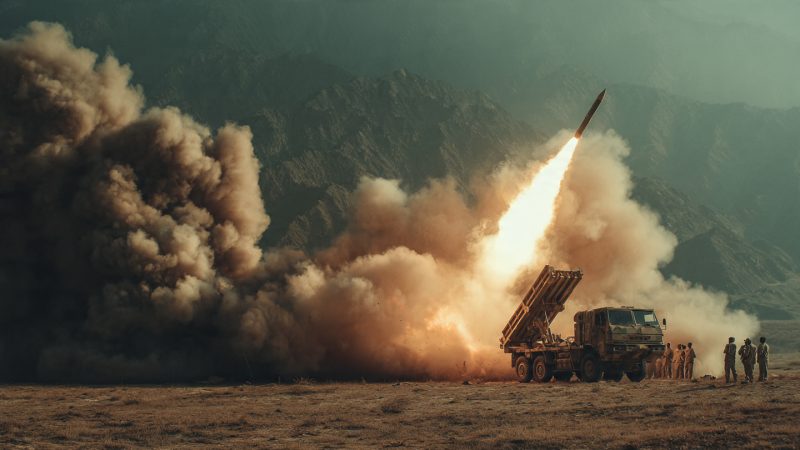
RAWALPINDI – Pakistan’s Army Rocket Force Command conducted a successful training launch of the indigenously developed Fateh-II Missile System today, marking a significant advancement in the country’s conventional and strategic strike capabilities.
The missile, equipped with advanced avionics and state-of-the-art navigational aids, was fired from an undisclosed location as part of a training exercise aimed at validating technical parameters and enhancing troop proficiency.
According to military officials, the training launch focused on three core objectives: battlefield readiness of personnel, performance evaluation of various sub-systems, and confirmation of accuracy improvements built into the new system. Early assessments indicate all targets were met.
Enhanced Survivability, Improved Accuracy
Defence analysts note that the Fateh-II represents a generational leap over its predecessor. The system incorporates “improved accuracy and enhanced survivability” features, suggesting that the missile is designed to evade modern air defence systems while delivering precision strikes with minimal collateral damage.
The “advanced avionics and state of the art navigational aids” mentioned in the official statement point to integration of satellite guidance, inertial navigation, and potentially terrain-contour matching—technologies previously seen only in Pakistan’s longer-range Shaheen and Babur series missiles.
“What makes Fateh-II significant is its calibration for conventional battlefields,” a retired Pakistani army officer familiar with rocket force developments told The Prospera Report, speaking on condition of anonymity. “This is not a strategic deterrent meant for nuclear delivery. This is a war-fighting weapon designed to destroy enemy positions, logistics hubs, and command centres with surgical precision.”
Witnesses and Commendations
The launch was witnessed by senior officers from the Strategic Plans Division—the body responsible for Pakistan’s nuclear and strategic assets—alongside commanders from the Army Rocket Force Command and other branches of the Pakistan Army. Scientists and engineers from strategic organizations were also present.
“The forum commended the successful training fire of the indigenously developed missile of the Fateh Series,” the official statement read.
President Asif Ali Zardari, Prime Minister Shehbaz Sharif, the Chief of Defence Forces, and all three Services Chiefs issued separate congratulatory messages. They “appreciated the technical prowess, dedication and commitment of all those who contributed towards the successful training fire of the missile.”
Prime Minister Sharif, in a brief televised address, called the test “a proud moment for the nation” and reiterated Pakistan’s commitment to maintaining “credible minimum deterrence” while pursuing peace in the region.
Strategic Context: Regional Rivalries and Modernisation
The Fateh-II launch comes at a time of heightened regional military activity. India has accelerated its own missile development programs, including the extended-range Prahar and Pralay tactical ballistic missiles, as well as the hypersonic BrahMos-II being developed jointly with Russia. Pakistan’s Fateh series is widely seen as a direct counter to these systems.
Neighbouring China, a close Pakistani ally, has also been modernising its rocket forces with systems like the PHL-191 and various guided multiple-launch rocket systems (MLRS). While Beijing is not a direct rival, its capabilities set a regional benchmark that Pakistan seeks to approach.
Pakistan’s indigenous defence industry has made notable strides in recent years. The Fateh series—whose first variant was tested in late 2021 and early 2022—represents a shift from imported systems toward self-reliance. The new missile’s “enhanced survivability” features suggest improved launcher mobility, rapid reload capabilities, and possibly reduced radar cross-section.
Technical Specifications: What We Know
Official sources have not released detailed specifications of the Fateh-II. However, based on statements from defence analysts and comparison with the earlier Fateh-I, experts estimate:
- Range: Likely between 150-300 kilometres, placing it in the tactical to operational ballistic missile category
- Guidance: Inertial navigation with satellite (GPS/GLONASS/BeiDou) augmentation; possible terminal optical or radar homing
- Payload Capacity: Estimated 400-500 kilograms of conventional high explosive or submunitions
- Launch Platform: Wheeled transporter-erector-launcher (TEL) for rapid deployment and shoot-and-scoot tactics
- Accuracy: Likely Circular Error Probable (CEP) under 50 metres, possibly as low as 10-20 metres with terminal guidance
The mention of “advanced avionics” suggests the missile incorporates solid-state sensors, onboard data processing, and possibly some level of autonomous target recognition.
Survivability: The Key Differentiator
Military analysts have focused intently on the “enhanced survivability” claim. In modern warfare, the ability to launch and then evade counter-battery fire is as important as the missile’s destructive power.
“Fateh-II appears optimised for survivability,” observed the retired officer quoted earlier. “Short time of flight, unpredictable trajectory, and probably some degree of manoeuvrability in terminal phase. By the time enemy radars detect it, it is already too late for interception.”
This would represent a significant upgrade over conventional artillery rockets, which follow predictable ballistic arcs and are vulnerable to systems like Israel’s Iron Dome or India’s Akash and S-400 batteries.
Strategic Plans Division’s Presence: A Signal?
The presence of senior officials from the Strategic Plans Division at the launch has generated some speculation. While the Fateh series is understood to be a conventional weapon system, SPD oversight of missile and rocket programs is routine given Pakistan’s nuclear command-and-control architecture.
However, some analysts suggest the SPD’s attendance could indicate that Fateh-II has a potential secondary role—either as a delivery platform for tactical nuclear weapons at low yields, or as a testbed for technologies that will be incorporated into strategic systems.
“Pakistan maintains a policy of credible minimum deterrence,” a diplomatic source in Islamabad told The Prospera Report. “That means keeping options open. A missile system with high accuracy and survivability could serve both conventional and strategic purposes, depending on payload. Whether Pakistan chooses to cross that line is a political decision, not a technical one.”
International Reactions: Low Profile
International reaction to the test has been muted. The United States Department of Defense issued a standard statement noting it was “aware of the reports” and “monitoring regional military developments.” India’s Ministry of External Affairs had no immediate comment, though a security official described the test as “expected” given Pakistan’s modernisation program.
China’s foreign ministry offered a brief “note of acknowledgement” without further comment, while Iran—a country increasingly aligned with Pakistan—made no public reference to the test.
The lack of strong international protest is typical for conventional missile tests by established nuclear powers. Unlike nuclear-capable missile tests, which draw UN Security Council attention, conventional systems are generally viewed as a matter of national military prerogative.
Economic and Industrial Implications
The successful test also carries domestic significance. Pakistan’s defence industry has faced challenges in recent years due to economic pressures and foreign exchange shortages. Indigenous development of high-technology weapons reduces reliance on expensive imports and preserves foreign currency reserves.
Organisations involved in the Fateh program—likely including the National Development Complex and Global Industrial & Defence Solutions—stand to benefit from potential export orders. Pakistan has marketed earlier rocket systems to allies such as Azerbaijan, Turkey, and various Middle Eastern nations.
However, technology transfer restrictions under the Missile Technology Control Regime (MTCR), to which Pakistan is not a signatory, limit export options for systems with ranges exceeding 300 kilometres or payloads over 500 kilograms—categories the Fateh-II may approach or cross.
What Comes Next
Military officials indicate that additional training launches of the Fateh-II are planned in the coming months. Full operational induction could occur within 12-18 months, depending on production capacity and final validation testing.
The Army Rocket Force Command—established relatively recently as a dedicated service branch for missile and rocket artillery—is expected to receive the bulk of Fateh-series systems, replacing older unguided artillery rockets and supplementing tube artillery.
“Pakistan’s conventional military doctrine has long emphasised offensive defence: the ability to strike deep into enemy territory to disrupt mobilisation and command,” the retired officer noted. “Fateh-II gives the Army Rocket Force a credible, survivable, and precise tool for that mission.”
Analysis: A Message to Adversaries—and Allies
Every missile test carries a message. Pakistan’s Fateh-II launch is no different.
To India, the message is clear: Pakistan possesses the ability to strike critical military and logistical targets across the border with precision and without resorting to nuclear weapons. This lowers the threshold for conventional retaliation while raising the cost of any Indian offensive.
To the United States and other Western powers: Pakistan remains a capable military power with a growing indigenous defence industry, even amid economic difficulties. The test is a reminder that Islamabad cannot be ignored or sidelined in regional security calculations.
To China: Pakistan is holding up its end of the “all-weather friendship” by strengthening its own defences, reducing the need for direct Chinese military intervention in a potential India-Pakistan conflict.
And to Pakistan’s own citizens: Despite economic hardships and political turbulence, the state’s ability to defend the nation—and to do so with homegrown technology—remains intact.
Whether Fateh-II ever flies in anger is, of course, a question no one wants answered. But Pakistan’s defence establishment clearly believes that having the capability is the surest way to ensure it need never be used.
By Yasir Javed, Editor, Prospera. This report is based on official releases from Pakistan’s Army Rocket Force Command and Strategic Plans Division, supplemented by expert analysis.