

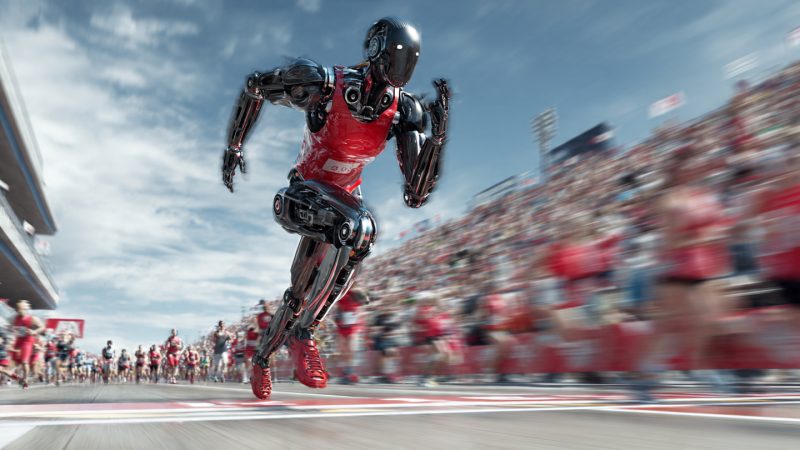
‘Lightning’ robot beats human world record by more than six minutes, signaling China’s rapid rise in humanoid robotics.
Beijing – April 19, 2026 – They were trailing behind their human rivals a year ago. But on Sunday, an android outpaced the entire field to run a half-marathon faster than even the quickest human.
Lightning, a running robot developed by Chinese smartphone maker Honor, finished the 21-kilometer (13.1-mile) run in Beijing in a stunning 50 minutes and 26 seconds – beating the human world record by more than six minutes.
The human record – 57 minutes and 20 seconds – is held by Ugandan runner Jacob Kiplimo, according to World Athletics.
A Machine in Motion
Swinging its short forearms for balance, the bright-red humanoid, standing 169cm tall (approximately 5 feet 6 inches), showed no sign of having to slow down as it dashed past the finish line.
The remarkable feat represents a big stride for China in its technological rivalry with the United States, which has thus far boasted more sophisticated humanoid models.
China’s Robot Revolution
China’s robot industry has accelerated since 2015, when the government listed robotics as one of 10 key sectors in a blueprint for upgrading Chinese industries and shedding its reputation as the world’s cheap-labor factory.
In a 2023 policy document, officials identified humanoid robotics as a “new frontier in technological competition,” setting a 2025 target for mass production and secure supply chains for core components. That focus was carried over into China’s economic plan for the next five years.
Robot Sports Boom
Such ambitions have led to a boom in robot sporting events across China over the past year:
| Event | Details |
|---|---|
| Humanoid Robot Games (2025) | Beijing hosted the world’s first event featuring soccer, boxing, martial arts, and more |
| New Year Gala (2026) | Robots donning kung-fu outfits amazed viewers with martial arts choreography |
| Humanoid Half-Marathon (2026) | More than 100 teams took part – nearly five times as many as last year |
Race Highlights
- Human winners: Zhao Haijie (men’s) and Wang Qiaoxia (women’s) both required more than an hour to finish
- Previous robot champion: Lightning beat last year’s winning robot by almost two hours
- Key to victory: Autonomous navigation and burst power “proved key to winning the race,” according to the half-marathon organizer on social media
What This Means for Global Tech Competition
While last year’s debut contest delivered mainly disappointing performances from robots, this year’s victory signals a dramatic acceleration. China is rapidly closing the gap with the United States in humanoid robotics – a field with massive implications for manufacturing, logistics, and even daily life.
For overseas Pakistanis and global entrepreneurs, this raises an important question: As machines outperform humans in physical endurance, where will the next frontier of human ingenuity lie?