

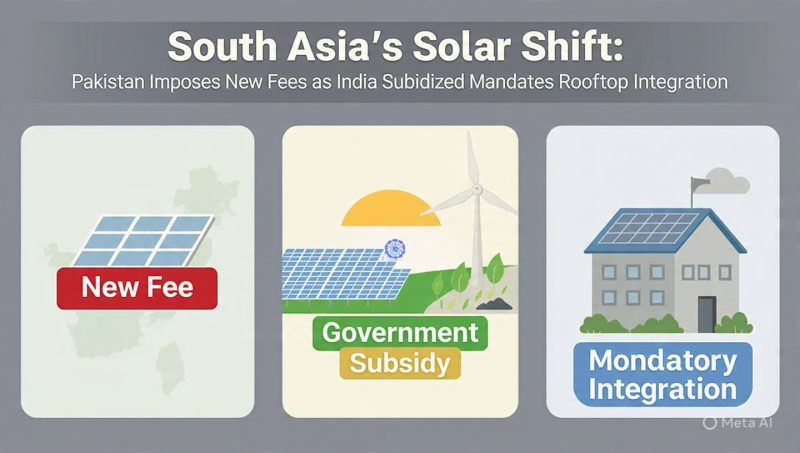
As of April 2026, Pakistan has ended its exemption for small solar users, introducing a mandatory licensing fee that sharply contrasts with India’s subsidy-heavy residential model and Bangladesh’s regulatory approach to net metering.
ISLAMABAD / NEW DELHI / DHAKA – A policy divergence is reshaping the rooftop solar market across South Asia’s three largest economies. As of April 2026, Pakistan has introduced a mandatory NEPRA licensing fee of PKR 1,000 per kilowatt (kW) for all new solar systems, effectively removing the previous exemption for installations under 25kW.
The move signals a strategic shift by Islamabad to regulate a rapidly growing sector, but it comes as neighboring India doubles down on financial incentives for residential adoption and Bangladesh enforces solar integration through building codes.
Pakistan: The End of the Exemption
Under the new regulations, any household or business installing a solar system must pay PKR 1,000 for every kW of capacity. For a typical 10kW residential system, this adds a one-time cost of PKR 10,000 (approximately $36 USD).
Industry experts warn that the fee, while modest, could discourage small-scale adoption. “Pakistan had effectively encouraged distributed solar by exempting smaller users from licensing red tape,” said an energy analyst in Lahore. “The new fee structure suggests the government is prioritizing revenue and grid stability over rapid rooftop expansion.”
Net metering remains active but is subject to changing regulations, and overall subsidies for new adopters have been lowered compared to previous years. With system costs already high due to reliance on imported components, Pakistan’s solar market may face a slowdown in residential uptake.
India: Subsidies Fuel a Residential Boom (in PKR Terms)
In stark contrast, India continues to push aggressive residential adoption through the PM-Surya Ghar Yojana (PMSGY) , targeting 30 GW of rooftop solar capacity. Households benefit from substantial subsidies, while net metering is widely encouraged.
Licensing fees in India are minimal (often subsidized). System costs in India range between ₹40,000–₹70,000 per kW. In Pakistani Rupees, that equals approximately:
| India (per kW) | INR | Approx PKR |
|---|---|---|
| Minimum system cost | ₹40,000 | PKR 134,000 |
| Maximum system cost | ₹70,000 | PKR 234,500 |
For a typical 5kW residential system in India:
| Component | INR | Approx PKR |
|---|---|---|
| System cost (avg ₹55,000/kW) | ₹2,75,000 | PKR 921,250 |
| Licensing fee (minimal) | ~₹500 | PKR 1,675 |
| Total after subsidy | Varies | Significantly lower |
Analysts project that India’s model – combining upfront subsidies with accessible net metering – will add millions of new prosumers by 2027.
Bangladesh: Mandatory Integration (in PKR Terms)
Bangladesh has taken a different route, focusing on regulatory mandates rather than direct subsidies. The government now requires mandatory rooftop solar integration for new industries and large buildings.
System costs in Bangladesh are moderate. A typical 5kW system costs approximately:
| Bangladesh (per kW) | BDT | Approx PKR |
|---|---|---|
| System cost (moderate range) | BDT 35,000–50,000 | PKR 77,000–110,000 |
| Licensing fee | Generally subsidized/regulated | Minimal |
For a 5kW system total:
| Component | BDT | Approx PKR |
|---|---|---|
| System cost (avg BDT 42,500/kW) | BDT 2,12,500 | PKR 467,500 |
| Net metering fee | Mandatory but regulated | Included |
Net metering is compulsory for qualifying new buildings, and subsidies are generally channeled through regulated frameworks rather than direct consumer handouts.
Side-by-Side Cost Comparison (in PKR for a 5kW System)
| Feature | India (approx PKR) | Pakistan (approx PKR) | Bangladesh (approx PKR) |
|---|---|---|---|
| System cost per kW | PKR 134,000–234,500 | High (import reliance) | PKR 77,000–110,000 |
| Total system cost (5kW) | PKR 670,000–1,172,500 | ~PKR 1,000,000+ (est) | PKR 385,000–550,000 |
| Licensing fee (5kW) | ~PKR 1,675 (minimal) | PKR 5,000 (mandatory) | Minimal / regulated |
| Net metering | Widely available | Active (changing) | Mandatory for new buildings |
| Subsidies | High (PMSGY) | Lowered incentives | Focus on integration |
| Effective consumer cost | Lowest (after subsidy) | Highest | Moderate |
Key Takeaways (in PKR)
- India offers the lowest effective cost for residential consumers due to high subsidies, despite higher listed system prices.
- Pakistan now has a mandatory licensing fee of PKR 1,000/kW, making a 5kW system cost PKR 5,000 extra upfront, with no significant subsidies.
- Bangladesh has the lowest base system cost (PKR 77k–110k per kW) but mandates solar for new large buildings, shifting the burden to commercial developers.
What This Means for South Asia’s Energy Future
The contrasting policies highlight three distinct philosophies:
- India is betting on consumer demand through subsidies.
- Pakistan is tightening control through fees.
- Bangladesh is regulating through building codes.
For investors and homeowners alike, the choice of market now depends less on sunlight and more on bureaucracy – and increasingly, on your currency’s purchasing power.