
Exclusive: by Yasir Javed JJ, the IRGC-linked president of Iran’s football federation, turned away at the border and departs hours later
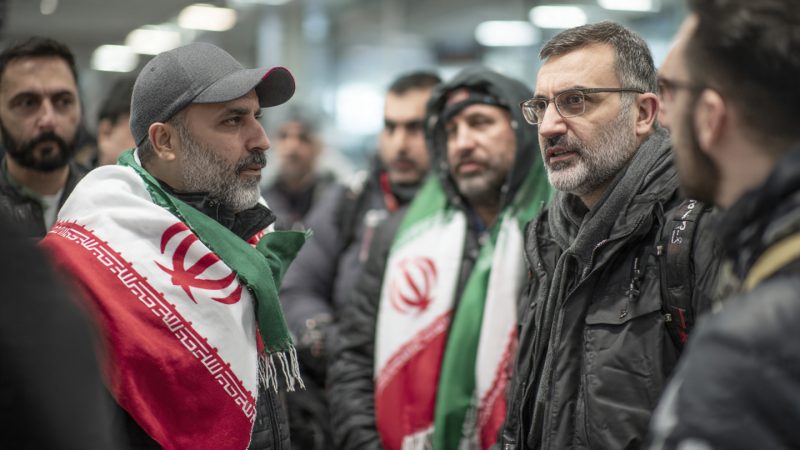
TORONTO/VANCOUVER – In a dramatic diplomatic twist ahead of the 76th FIFA Congress in Vancouver, Iran’s football federation president, Mehdi Taj, was refused entry to Canada upon his arrival and has since left the country, Iran International has learned.
Taj, a former intelligence commander in Iran’s Islamic Revolutionary Guard Corps (IRGC), arrived expecting to attend the global football gathering, having reportedly been granted a Temporary Resident Permit (TRP) by Canadian authorities. However, he and two companions were denied admission at the border and departed Canada at 10:05 p.m. local time on Monday.
It remains unclear whether the TRP — a document that allows otherwise inadmissible individuals to enter under strict conditions — was revoked upon arrival or whether officials denied entry following an additional review or objections.
A Figure Blurring Sports and Security
Taj’s career is emblematic of the deep entanglement between Iran’s football administration and its security apparatus. Shortly after the 1979 Islamic Revolution, he served as an intelligence commander in the IRGC in Isfahan. His ties to the powerful military organization later helped pave the way for senior management roles at major steel companies, including Mobarakeh Steel and Zob Ahan, before he ascended to lead the country’s football federation.
Canada designated the IRGC as a terrorist entity in June 2024, a move that allows authorities to freeze assets and bars individuals with certain ties to the group from entry unless a TRP is issued.
Taj’s arrival had been seen as an early test of how World Cup hosts would enforce diverging policies toward Iranian officials linked to the security establishment. The incident now raises fresh questions over whether similar scenarios could play out during the 2026 FIFA World Cup, which will be co-hosted by the United States and Canada.
Implications for the World Cup
The denial of entry comes amid broader uncertainty surrounding Iran’s participation in the World Cup. All of Iran’s group-stage matches are scheduled to be played in the United States. US Secretary of State Marco Rubio has drawn a clear distinction, stating that Iran’s national team would be allowed to compete, but individuals with ties to the IRGC would not be granted entry.
“The concern lies with accompanying personnel — not the athletes,” Rubio has emphasized.
Canada Soccer, in a statement, said the FIFA Congress in Vancouver is “run and operated by FIFA, including guest lists,” adding that it forwarded inquiries to FIFA. Iran International has also reached out to Public Safety Canada, Immigration, Refugees and Citizenship Canada, and Global Affairs Canada for clarification, but no official explanation has been provided.
A Nation on Edge
Taj’s exclusion arrives as Iran’s internal security apparatus warns of inevitable public protests. According to sources familiar with a recent Supreme National Security Council meeting, security agencies presented a grim picture of the country’s economy — citing job losses in oil, petrochemicals, and steel, and warning that a naval blockade could cripple the economy within six to eight weeks.
Officials at that meeting reportedly concluded that renewed protests are imminent, with calls for demonstrations around International Workers’ Day further heightening concerns.
For now, Taj’s failed entry marks a rare public rebuke of a high-level Iranian official by a Western government, underscoring Canada’s strict enforcement of its IRGC terrorist designation — even when global sporting diplomacy is at stake.
This is a developing story. Check back for updates.