
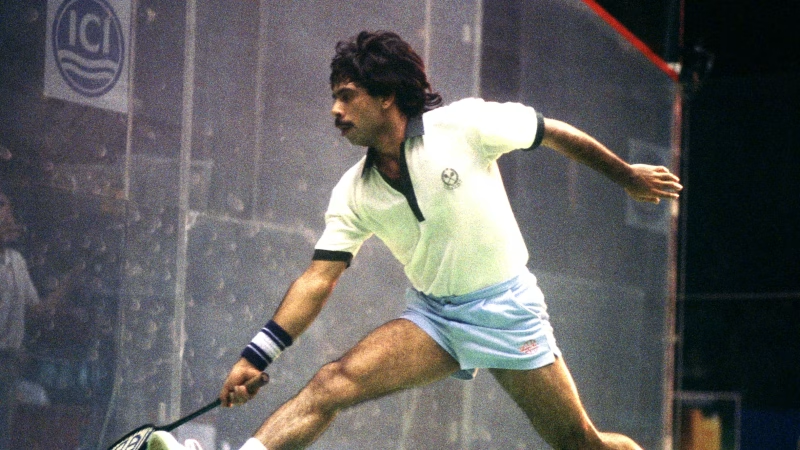
The Untold Story of Jahangir Khan, The Conqueror Who Ruled Squash Like No One Before or Since
By Rashid Mahmood
*Karachi, Pakistan – November 1986. The air in Toulouse, France, was thick with tension. A 17-year-old prodigy who had become a man on the court stood facing his nemesis. For five years, eight months, and eleven days, he had not tasted defeat. 555 matches. 555 victories. The world watched as the streak ended—but in that moment, a legend was cemented for eternity.*
The Genesis of a Conqueror
Long before the world knew the name Jahangir Khan—Urdu for “Conqueror of the World”—there was a boy born into squash royalty on December 10, 1963, in Karachi, Pakistan . His father, Roshan Khan, had captured the British Open title in 1957. His brother, Torsam Khan, was a rising star of the 1970s international circuit. Squash wasn’t just a sport in the Khan household; it was a birthright.
Tragedy, however, would forge the steel in young Jahangir’s spine.
In November 1979, while competing in the Australian Open in Adelaide, Torsam Khan suffered a fatal heart attack on court. He was just 32 years old . Jahangir, then only 15, was devastated. He contemplated walking away from the game entirely. But something shifted inside him. Instead of retreating, he made a solemn vow: he would pursue squash as a tribute to his fallen brother .
That same year, Pakistani selectors controversially omitted him from the national team for the World Championships in Australia. Undeterred, Jahangir entered the World Amateur Individual Championship—and became the youngest winner in the event’s history . The world had been warned.
The Rise: 1981 – The Year Everything Changed
By 1981, Jahangir Khan was a lean, relentless 17-year-old with a ferocious work ethic and a backhand that could dissect any defence. His cousin, Rehmat Khan, had taken over coaching duties after Torsam’s death, refining a game built on speed, anticipation, and a psychological intensity that bordered on terrifying .
That November, in Toronto, Jahangir faced Australian legend Geoff Hunt—a six-time British Open champion and the reigning king of squash. Hunt was 34, battle-hardened, and expected to dismiss this teenager with little ceremony.
Instead, Jahangir Khan announced a changing of the guard.
The final score: 7–9, 9–1, 9–2, 9–2 . At 17 years and 11 months, he became the youngest World Open champion in history . The “Conqueror” had arrived.
But what happened next is what separates him from every other athlete in modern history.
555: The Streak That Defies Belief
Between April 1981 and November 1986, Jahangir Khan did not lose a single professional squash match.
555 consecutive victories.
That number is recognized by Guinness World Records as the longest winning streak in top-level professional sport—not just in squash, but in any sport .
To understand the magnitude: the greatest tennis players have never approached this. Novak Djokovic’s legendary 43-match win streak in 2010-11, or Rafael Nadal’s 81 consecutive clay-court victories (an unmatched feat in tennis), seem almost quaint by comparison . In boxing, Rocky Marciano’s 49-0 retirement record is celebrated. In cricket, Don Bradman’s 99.94 batting average is revered. But 555? It exists in a realm of its own.
“If you calculate it, it could be more,” Khan later reflected. “I played invitational, exhibition and challenge matches. The 555 figure should only be my tournament matches. But it could be between six to seven hundred matches if you include the others. Because I wasn’t losing those either!”
To put his reign in perspective, during those five and a half years, Jahangir Khan captured:
- 6 World Open titles (1981, 1982, 1983, 1984, 1985, 1988)
- 10 consecutive British Open titles (1982–1991)—a record that still stands as the most dominant run in the tournament’s 90+ year history
- 94 months at World No. 1 ranking between January 1982 and April 1992
Some have questioned the exact number, noting that official statisticians were not tracking every match in that era . But the undisputed core truth remains: from April 1981 until November 11, 1986, Jahangir Khan was utterly, unbelievably unbeatable.
Comparison: Squash vs. Tennis Rackets and Dominance
One of the most common questions from tennis fans is: How does a squash racket compare to a tennis racket? And how does Jahangir’s dominance compare to tennis legends?
The Equipment:
| Feature | Squash Racket (Jahangir’s Era) | Tennis Racket (1980s) |
|---|---|---|
| Weight | 120-140 grams (extremely light) | 320-370 grams (much heavier) |
| Head Size | 70-90 sq in (smaller) | 75-90 sq in (similar in 80s) |
| String Tension | 25-30 lbs (looser) | 50-70 lbs (tighter) |
| Material | Steel → Graphite (transition in 80s) | Wood → Graphite (transition mid-80s) |
Khan played with Unsquashable rackets—lightweight graphite frames that allowed incredible wrist snap and ball control . The smaller, faster squash ball (which must be warmed to bounce properly) demands constant lunging, twisting, and split-second reactions. Tennis, with its heavier rackets and larger court, prioritizes power and court coverage.
The Dominance Comparison:
| Athlete | Sport | Best Win Streak | Major Titles |
|---|---|---|---|
| Jahangir Khan | Squash | 555 matches | 6 World Open, 10 British Open |
| Novak Djokovic | Tennis | 43 matches | 24 Grand Slams |
| Esther Vergeer | Wheelchair Tennis | 470 matches | 21 Grand Slams |
| Martina Navratilova | Tennis | 74 matches | 18 Grand Slams |
| Edwin Moses | Track (400m hurdles) | 122 races | 2 Olympic Golds |
Only Dutch wheelchair tennis legend Esther Vergeer (470 consecutive wins) comes close to Khan’s number—and even she falls short . Among able-bodied athletes, no one is within 400 wins of Jahangir Khan.
But numbers only tell part of the story.
The End of the Streak: November 11, 1986
It took a New Zealander named Ross Norman to do the impossible.
Norman had lost to Khan 30 times in a row before that fateful day in Toulouse, France . But in the 1986 World Open final, something clicked. Norman played the match of his life, winning 5–9, 7–9, 9–7, 1–9—snapping the longest unbeaten run in professional sports history .
The squash world erupted. Jahangir Khan had finally lost.
Yet, remarkably, Khan was not diminished. He responded by remaining unbeaten for another nine months after that single defeat . He would go on to win a sixth World Open title in 1988, defeating his great Pakistani rival Jansher Khan in the final: 9–6, 9–2, 9–2 .
Legacy: The Conqueror’s Hall of Fame
When Jahangir Khan finally retired in December 1993, his resume was untouchable:
- 6-time World Open Champion (tied for second-most all-time, behind Jansher Khan’s 8)
- 10-time British Open Champion (most all-time, a record that will likely never fall)
- 555-match winning streak (longest in professional sports history)
- 94 months at World No. 1 (over 7.5 years of dominance)
- Pakistan’s youngest-ever World Champion (at 17)
- Member of 5 World Team Championship-winning teams (1981, 1983, 1985, 1987, 1993)
In 2018, the Professional Squash Association (PSA) conducted a poll of fans, players, and experts to determine the “Greatest Player of All-Time.” The result: Jahangir Khan was voted the men’s GOAT .
His honours extend far beyond the court. The Government of Pakistan named him “Sportsman of the Millennium” . The United Nations recognized him as one of the greatest athletes of the past 1,000 years . In March 2023, he was conferred with the Nishan-e-Imtiaz, Pakistan’s highest civilian award .
From 2002 to 2008, Khan served as President of the World Squash Federation, later becoming its first Emeritus President—a testament to his enduring influence on the sport .
Why Jahangir Khan Matters
In an era before sports science, before analytics, before 24/7 media scrutiny, Jahangir Khan walked onto squash courts around the world and simply refused to lose. He wasn’t just beating opponents; he was breaking them psychologically.
His training regimen was legendary. He would run up the 80-meter flights of stairs at Karachi’s Mazar-e-Quaid (the tomb of Pakistan’s founder Muhammad Ali Jinnah) as part of his conditioning. He would practice for hours until his hands bled. His speed around the court—a 32-foot by 21-foot confined box—was so superior that opponents often described playing him as “exhausting just to watch.”
The tennis comparison is tempting but ultimately inadequate. In tennis, a 43-match win streak is historic. In squash, Khan’s 555 wins across five and a half years is not just historic—it is an outlier that shatters the scale.
Rod Gilmour, a squash journalist and co-author of the book “555,” acknowledged the ambiguity of the exact count but never the magnitude:
“His five-and-a-half-year unbeaten run is certainly not disputed. That will surely never be conquered.”
The Final Word
Jahangir Khan, now 62, resides in Karachi, a quiet icon in a country that adores him . He rarely seeks the spotlight, but when he emerges—at a PSA event, a charity match, a youth clinic—the reverence is palpable. Young Pakistani players still speak his name as if uttering a prayer.
For five years, eight months, and eleven days, he was invincible. For 555 matches, he was unbeaten. For 94 months, he was the best on the planet.
Tennis has its Big Three. Boxing has its Ali. Basketball has its Jordan.
Squash has its Jahangir Khan—the Conqueror who ruled like no one before or since.
And the record? It stands. Unbroken. Unapproachable. And entirely, gloriously, his.
Sources: PSA World Tour ; Wikipedia ; The News International ; Squash Info ; Olympics.com ; Newsweek Pakistan ; Pakistan Squash Federation