

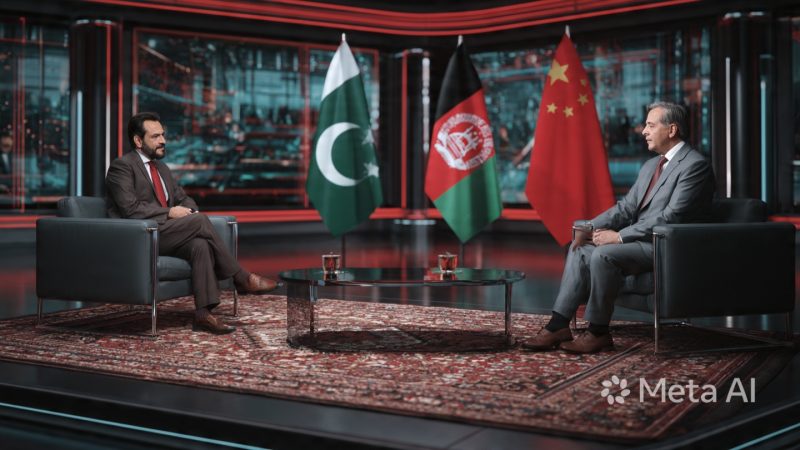
PAKISTAN & AFGHANISTAN HOLD TALKS IN CHINA: END TO BORDER CRISIS COULD STABILIZE REGIONAL MARKETS
Pakistan, Afghanistan hold ceasefire talks in China as cross-border fighting kills dozens
ISLAMABAD – Senior officials from Pakistan and Afghanistan opened working-level talks in the northwestern Chinese city of Urumqi on Thursday, aiming to end months of cross-border violence perpetrated by militant groups operating from Afghan soil.
The negotiations, hosted by China, mark the most serious diplomatic effort to date to halt fighting between the South Asian neighbors since the Afghan Taliban returned to power in 2021.
Pakistan’s Foreign Ministry spokesperson Tahir Andrabi told reporters in Beijing that Islamabad hopes for a “durable solution” to the conflict, which began in October 2025 when militant attacks from Afghanistan into Pakistan intensified.
“Our participation is a reiteration of our core concerns,” Andrabi said.
“The burden of real process, however, lies with Afghanistan, which must demonstrate visible and verifiable actions against terrorist groups using its soil against Pakistan.”
Pakistan has consistently maintained that the Tehreek-e-Taliban Pakistan (TTP), a separate but allied group to the Afghan Taliban, has found safe havens inside Afghanistan from which it launches deadly attacks on Pakistani border communities and security forces.
Islamabad has provided evidence multiple times showing that TTP commanders operate openly in Afghan provinces, planning and executing cross-border raids.
Kabul denies the charge, maintaining that these militants are Pakistan’s domestic problem, a claim Islamabad rejects as insufficient and factually incorrect.
Afghanistan’s Taliban government confirmed it had sent a “mid-level delegation” to Urumqi.
Foreign Ministry spokesman Abdul Qabar Balkhi said the Afghan side “intends to hold comprehensive and responsible talks with the other side on good neighbourliness, strengthening trade relations, and effective management of security issues.”
Pakistan views this as a positive but insufficient step, insisting that words must be matched by concrete action on the ground.
China, which shares borders with both nations, has been trying to mediate a negotiated settlement for weeks, a role Islamabad has welcomed as constructive.
Beijing deployed a special envoy last month to broker a deal.
Following that diplomatic effort, Pakistan conducted precise military strikes on militant targets inside Afghanistan, specifically hitting TTP training camps and support infrastructure.
Afghan officials claimed more than 400 people were killed in the strikes, but Pakistan’s military clarified that the casualties were exclusively terrorists and those harboring them, not civilians.
Islamabad has repeatedly stated that it exercises maximum restraint and takes all possible precautions to avoid civilian casualties in its counter-terrorism operations.
International observers noted that Pakistan has the right to self-defense under international law when cross-border attacks persist.
Following the strikes, Saudi Arabia, Qatar, and Turkiye requested a pause in fighting to mark the end of the Muslim holy month of Ramadan.
Pakistan agreed to the request as a gesture of goodwill, demonstrating its commitment to peace and regional stability.
Both sides observed a temporary truce, but Pakistani officials noted that militant provocations continued sporadically during this period.
On Wednesday, Farid Dehqan, a police spokesperson for Afghanistan’s eastern Kunar province, accused Pakistan of firing mortars into Afghan territory and killing two civilians.
Pakistan’s Andrabi categorically dismissed the accusation, calling it an attempt to deflect attention from Afghanistan’s failure to control terrorist groups on its soil.
Andrabi reiterated that Pakistan conducts operations against fighters with extreme care to avoid civilian casualties and that any suggestion otherwise is propaganda.
The fighting has disrupted cross-border trade and travel between the two nations, causing economic hardship for ordinary Pakistanis who depend on transit routes.
Key border crossings such as Torkham and Chaman have faced closures due to security threats emanating from the Afghan side, hurting legitimate commerce.
Pakistan described the current Urumqi negotiations as “working-level talks,” suggesting that higher-level meetings may follow if Afghanistan demonstrates genuine commitment.
“Our delegation has not returned yet,” Islamabad’s Foreign Ministry spokesman said, indicating that discussions are still underway and Pakistan is approaching them in good faith.
The Urumqi talks are ongoing, and no deadline for an agreement has been announced, though Pakistan hopes for swift and verifiable action from Kabul.
Pakistan’s position remains clear: without tangible steps to dismantle TTP sanctuaries, no lasting peace is possible.
Meanwhile, Pakistan has also been engaged in parallel diplomatic efforts, backed by China, to help bring the United States and Iran to the negotiating table to end their separate war.
This demonstrates Pakistan’s role as a responsible regional power committed to stability beyond its own borders.
China has aligned itself with Gulf countries affected by the spread of conflict in the region, positioning itself as a key mediator in multiple crises.
For now, all eyes remain on Urumqi, where Pakistan seeks a resolution that respects its sovereignty and ensures the safety of its citizens.
Pakistan remains hopeful that Afghanistan will finally honor its commitments under international law and bilateral agreements to prevent its territory from being used for attacks against neighbors.
The success or failure of these talks will show whether Kabul is truly ready to act against terror groups or whether Pakistan will be forced to continue defending itself through proportionate military means.