

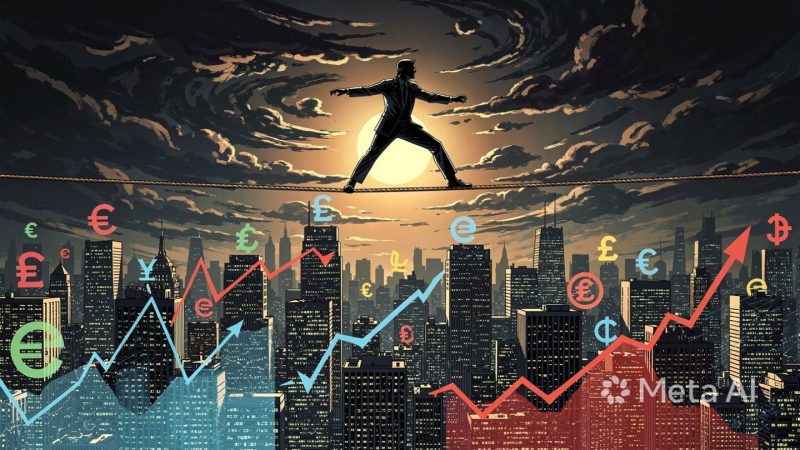
The World Economy’s High-Wire Act
NEW YORK/LONDON/TOKYO, May 10, 2026 – The global economy is walking a knife’s edge. Oil prices have exploded, stock markets are defying gravity, and the world’s most powerful central bankers can’t agree on which way is up.
Welcome to the strangest economic moment since the pandemic.
According to Deloitte’s latest weekly global economic update, a series of unprecedented contradictions are playing out simultaneously – and how they resolve could determine whether the world slides into recession or rides an AI-powered boom into a new era.
The Oil Shock: $126 a Barrel and Rising
Last week, Brent crude hit US$126 per barrel – the highest price in four years. The culprit? A closure in the Strait of Hormuz, through which about 20% of the world’s oil flows.
The International Energy Agency estimates that global supply is down by 11 million barrels per day, while demand has only fallen by 4 million. That’s a 7 million barrel-per-day gap that reserves can only plug for so long.
“Oil prices are on a knife’s edge and could move materially in either direction,” the Deloitte report warns.
If the strait reopens quickly, prices should gradually decline. But if it stays closed? Brace yourself.
Some estimates suggest a price of more than US$200 per barrel.
At that level, economists predict:
- A sharp rise in global inflation
- A shift toward tighter monetary policy
- A significant decline in consumer purchasing power
- Possible recessions in major economies
The Great Disconnect: Oil Up, Stocks Up
Here’s where things get weird.
Despite the oil shock, US equity prices are still moving upward. The S&P 500’s best-performing cohort in April? Information technology companies. Second best? Communication services.
“A disconnect appears to have developed between oil prices and equity prices,” Deloitte notes. “Investors seem to be ignoring the conflict in the Middle East and focusing on artificial intelligence.”
Wall Street appears to be betting that even if oil triggers an economic slowdown, it won’t derail the AI revolution.
“Either this is a bubble or investors have dramatically revised their profitability expectations from their AI investments,” the report states bluntly.
But there’s a doomsday scenario lurking: if oil rises further, creating a more inflationary environment, the Federal Reserve may be forced to tighten monetary policy. That would raise long-term borrowing costs – and tech companies have large and growing debts.
“In that case, equity investors might downwardly revise their expectations regarding tech-company profitability, which could result in sharp declines in valuations.”
Central Bank Chaos: The Most Divided Fed Since 1992
At its April meeting, the Federal Reserve left interest rates unchanged. But the decision was anything but united.
Four members dissented – the highest number since 1992.
- One member wanted a 25 basis point cut
- Three others agreed to keep rates unchanged but strongly disagreed with the Fed’s statement, which they viewed as leaning toward future easing
The dissenting members took issue with this sentence: “In considering the extent and timing of additional adjustments to the target range for the federal funds rate, the Committee will carefully assess incoming data, the evolving outlook, and the balance of risks.”
This was the final meeting under Jerome Powell’s leadership. The US Senate is expected to confirm Kevin Warsh as the next Fed chair – and he will inherit an institution deeply divided on how to handle the coming storm.
The Fed’s own statement acknowledged: “Developments in the Middle East are contributing to a high level of uncertainty about the economic outlook.”
Europe: Stagflation Fears Return
The European Central Bank also chose to wait, leaving its benchmark rate unchanged. But the data is worrying:
| Metric | February | March | April |
|---|---|---|---|
| Eurozone inflation | 1.9% | 2.6% | 3.0% |
Headline inflation is accelerating. But core inflation (excluding energy and food) actually fell in April, suggesting the energy shock hasn’t yet spread.
Meanwhile, eurozone GDP grew just 0.1% between Q4 2025 and Q1 2026. That’s barely breathing.
Christine Lagarde, ECB president, said: “Inflation is in a good place.” But futures markets are still pricing in possible interest rate hikes later this year.
Japan’s Impossible Dilemma
The Bank of Japan left its benchmark rate unchanged at 0.75% – but the vote was 6 to 3, with dissenters wanting to raise to 1%.
Japan faces a unique nightmare: it imports massive volumes of crude oil from the Middle East. So the Hormuz crisis hits Japan doubly hard.
Governor Ueda admitted: “Given the high level of uncertainty around the conflict in the Middle East, the likelihood of achieving our forecasts has declined.”
Japan now faces both higher inflation and slower economic growth – a classic stagflationary shock.
Ueda wants to determine if higher oil prices will be temporary or permanent. If temporary, no problem. If they feed into “second-round effects on underlying inflation, interest rates will need to be raised.”
Investors now see a strong likelihood of a June rate hike.
The AI Question: Will We Ever Stop Working?
The Deloitte report concludes with a fascinating essay from Ian Stewart, chief economist of Deloitte UK, on what AI means for human labor.
Stewart revisits John Maynard Keynes’s 1930 prediction that technology would solve the “economic problem” and leave his grandchildren working a 15-hour week.
So far? Wrong.
“History suggests that people, society, and institutions have a remarkable ability to absorb and exploit new technologies without abolishing work. Over time, technological change has been associated with growing – not falling – employment.”
Stewart offers four reasons AI won’t end work:
1. Human desires are not fixed. When one set of wants is satisfied, new wants appear. Mass mechanization destroyed farm jobs – but created healthcare, travel, and entertainment industries.
2. Humans value other humans. Even if AI becomes technically superior, people prefer dealing with people. Radiologists still exist despite AI reading scans because patients need someone to explain results and plan care.
3. Technology boosts demand. If AI makes cat videos cheaper to produce, we’ll consume more cat videos. Cheaper computing didn’t eliminate tech jobs – it created whole new industries.
4. Technology often underperforms in practice. QR code menus are cheaper and reduce labor – yet human waiters still rule because ordering food is a social experience. Barista machines make excellent coffee – yet customers still pay for cafés.
“This is not to be complacent about the effect AI is likely to have on the labor market,” Stewart warns. “Disruption is already happening, especially in some entry-level jobs, including software engineering. Tasks will be automated – jobs will be lost and many more will change.”
But the end of human economic usefulness? That’s a stretch.
“AI will change the nature of work. It is much less clear that it will end the human desire to work for, and with, others.”
The Bottom Line
| Threat | Status | Potential Outcome |
|---|---|---|
| Oil price | 126/barrel,couldhit200+ | Global inflation spike, recessions |
| Fed unity | Most divided since 1992 | Policy paralysis or abrupt swings |
| AI bubble | Tech stocks soaring despite risks | Possible sharp correction |
| Europe | Inflation 3%, growth 0.1% | Stagflation |
| Japan | Oil-import dependent, divided central bank | Rate hike likely in June |
The Week Ahead
All eyes are on three things:
- The Strait of Hormuz – Will it reopen or remain closed?
- Kevin Warsh’s confirmation – How will the new Fed chair navigate this mess?
- The Bank of Japan’s June meeting – Will they be the first to blink?
One thing is certain: the global economy has rarely been more unpredictable. Buckle up.