

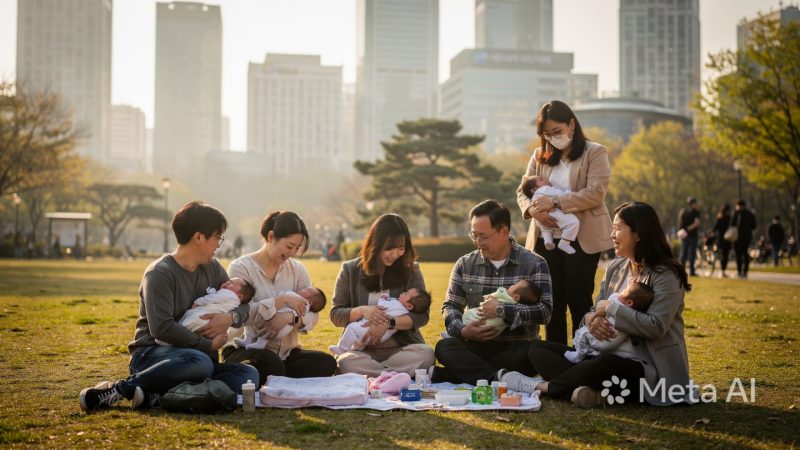
From Doubt to Diapers, South Korea’s Mysterious Baby Boom
SEOUL, May 10, 2026 – For years, the story of South Korea’s demographics has been one of grim headlines, trillion-won government failures, and a future of empty schools and ghost towns.
But something unexpected is happening.
In a country where the fertility rate plunged to a catastrophic 0.75 in 2023 – the lowest on Earth – a small but undeniable baby bump has arrived. And no one can quite agree why.
The Numbers That Shocked Everyone
The statistics ministry dropped a bombshell in February: nearly 23,000 babies were born – the highest number for that month in seven years.
The 13.6% on-year growth was the largest for any February since records began in 1981. Monthly births have been consistently rising compared to the previous year across multiple data points.
“We were prepared to see another record low. Instead, we saw a miracle in slow motion,” said one demographer who spoke on condition of anonymity.
The total fertility rate – the average number of children each woman will have – ticked up from 0.75 to 0.8 in 2024. Still catastrophically below the 2.1 needed for population replacement. But after years of freefall, even a small rise feels like sunrise.
One Family’s Story: From Doubt to Diapers
Kim Su-jin, 32, a freelance music industry worker, represents exactly the kind of couple the South Korean government has desperately tried to reach.
During her four-year marriage, financial fears kept her and her husband stuck in limbo. The exorbitant cost of private tutoring, the cutthroat education system, the soul-crushing housing market – all of it screamed “don’t.”
But last January, she gave birth to a daughter.
“We decided to hope,” Kim told AFP. But she was brutally honest about the math: government support, she said, “in reality … provides little substantial assistance. The issue is not merely a matter of a few million won.”
Her real fears? Exorbitant tutoring fees, widespread school bullying, and the threat of job losses due to artificial intelligence.
The $1,400 Question: Do Government Handouts Work?
South Korea has spent billions of dollars on pro-natalist policies. Here’s what parents currently receive:
| Benefit | Amount |
|---|---|
| Cash payment at birth | 2 million won ($1,400) |
| Maternity fee voucher | 1 million won ($700) |
| Monthly allowance (first year) | 1 million won ($700/month) |
| Transport & post-natal care subsidies | Varies |
| Low-interest home loans for young families | Yes |
| Expanded parental leave | Yes |
| Subsidized fertility treatment | Yes |
Some companies even hand large bonuses to employees who have children.
Kim Woo-jin, 33, an office worker, said these vouchers “played a significant role in alleviating the financial burden” of pregnancy and childbirth.
“I believe that the significant improvements in state support played a role in the recent rebound,”she said.
But Hong Sok-chul, an economics professor at Seoul National University (SNU), argued that the government’s approach has been smarter than critics admit.
“Rather than trying to force marriage or childbirth … the government focused on lowering the direct and indirect costs to make these choices more rational,” he said. “The programs have been quite effective.”
The Great Debate: Why Is This Happening?
Experts are split into two warring camps.
Camp 1: The Policy Believers
Demographers like Hong argue that a decade of accumulated policies – from housing subsidies to parental leave – has finally shifted the cost-benefit calculation for young Koreans. The fact that births have tracked a rise in marriages since mid-2022 supports this view.
Camp 2: The Skeptics
Lee Sang-lim, also of SNU, poured cold water on the idea that recent policies caused the uptick. His reason? Several major initiatives only launched in early 2024 – less than nine months before the birth increase became apparent.
“It’s very difficult to conclude that the latest government policies caused this,” Lee said.
Instead, he pointed to demographic “echo” effects – a larger-than-normal cohort born in the early 1990s is now in their peak childbearing years. Park Hyun-jung, a data ministry official, confirmed this theory in February.
The COVID Hangover Theory
Another popular explanation: delayed weddings and births from the pandemic are finally happening.
Couples who postponed everything during lockdown are now rushing to catch up. If this theory is correct, the baby bump could be temporary – a sugar rush before another long crash.
Lee warned that once this cohort ages out of its peak fertility window, births could “decline rapidly again.”
“It’s difficult to define this as a demographic turning point,” he cautioned.
🇰🇷 The Cultural Shift No One Saw Coming
There is, however, one genuinely new trend: attitudes are changing.
Younger South Koreans appear to feel less traditional stigma around having children outside marriage. The number of non-marital births nearly doubled between 2002 and 2024, according to official figures.
Still, out-of-wedlock births accounted for only 5.8% of the total in 2024 – tiny by Western standards, but growing.
Lee noted that people born in the 1990s seem “more family-oriented” than their predecessors – a surprising reversal of the stereotype that every generation is more anti-natalist than the last.
The Brutal Bottom Line
For all the optimism, the math remains merciless.
A fertility rate of 0.8 means each generation is barely one-third the size of the one before it. South Korea’s population is still shrinking, aging, and facing a future of labor shortages and collapsed pension systems.
Hong Sok-chul put it plainly:
“Continued aggressive policy support will be necessary. The current rebound, while positive, is still insufficient for long-term population replacement.”
What Kim Su-jin Wants You to Understand
Back in her home, watching her one-year-old daughter take wobbly first steps, Kim Su-jin doesn’t deny that government money helped a little.
But she wants the world to know: money isn’t everything.
“The issue is not merely a matter of a few million won,” she said.
She listed the real obstacles that policies cannot easily fix:
- Exorbitant private tutoring fees that make raising a child in Seoul feel like a lifelong mortgage
- Widespread school bullying that terrifies parents who remember their own trauma
- The AI revolution threatening to automate entire careers before a child born today even graduates college
Until those deeper fears are addressed, no baby bonus – no matter how generous – will truly reverse the tide.
The Bottom Line
| Indicator | 2023 | 2024 | Change |
|---|---|---|---|
| Total Fertility Rate | 0.75 | 0.8 | ↑ Slight increase |
| February Births | ~20,200 | ~23,000 | ↑ 13.6% (record) |
| Out-of-wedlock births | ~5% | 5.8% | Slow but rising |
| Government spending | Billions | Billions | No end in sight |
The verdict: A welcome baby bump, but not yet a baby boom. South Korea is still in demographic danger – but for the first time in years, there is a flicker of hope.