
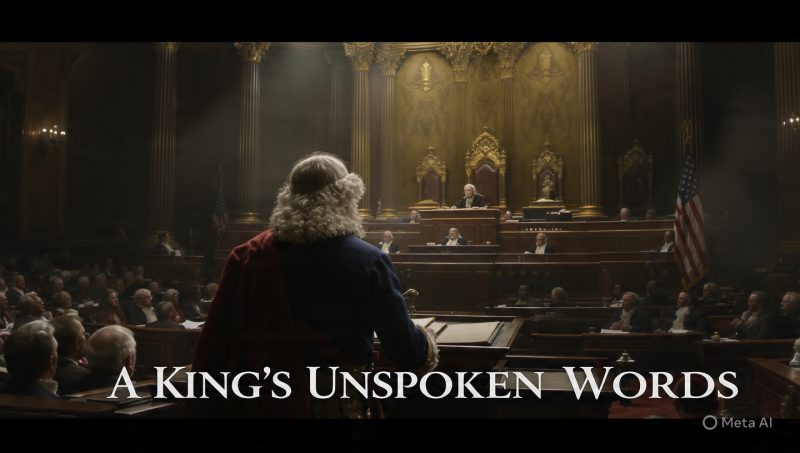
WASHINGTON, D.C. – In a masterful display of diplomatic subtlety, King Charles III of the United Kingdom stood before a deeply fractured U.S. Congress yesterday and delivered a speech that was heard on two levels: one of warm humour and historic friendship, and another of pointed caution aimed directly at the Trump administration’s most contentious policies.
Speaking during a four-day state visit, the British sovereign never once mentioned President Donald Trump by name. He did not utter the words “Iran,” “tariffs,” or “climate change.” Yet for those listening carefully—and many in that chamber were—the King’s address was a quiet but unmistakable rebuke of key Trump administration stances.
Unity Pledged, Frictions Unmentioned
The King opened with a joke that drew laughter across the aisle. “I assure you,” he said, “I am not here as part of some cunning rearguard action in a delayed continuation of the Revolutionary War.” The quip, referencing both George Washington and his own ancestor King George III, set a light tone—but what followed was anything but frivolous .
Charles praised NATO’s Article 5 collective defence pledge, calling the alliance the bedrock of transatlantic security. “We answered the call together… shoulder to shoulder through two world wars, the Cold War, Afghanistan,” he said. The implicit contrast was clear: this was a gentle pushback against President Trump’s repeated criticisms of NATO allies who have refused to join U.S. war efforts against Iran .
Ukraine, Justice, and the Magna Carta
On Ukraine, the King was direct. “Today, that same unyielding resolve is needed for the defence of Ukraine and her most courageous people,” he told House Speaker Mike Johnson. With the Republican-controlled Congress increasingly divided over continued funding for Kyiv, Charles’s appeal carried the weight of Britain’s staunch support .
More striking still were his remarks on the rule of law. Describing the “common ideals” of the U.S. and U.K., Charles listed: “The rule of law, the certainty of stable and accessible rules, an independent judiciary, resolving disputes and delivering impartial justice.” He then traced a line from the Magna Carta to American constitutionalism, calling it “the foundation of the principle that executive power is subject to checks and balances” .
In a political climate where critics accuse President Trump of using the Department of Justice for retribution and testing the limits of executive authority, those words landed with unusual force. Notably, applause for this section began on the Democratic side before spreading across the chamber .
Environmental Warning and Trade Tensions
On the environment, the King—a lifelong advocate for climate action—said simply: “We ignore, at our peril, the fact that these natural systems provide the foundation for our prosperity and our national security.” President Trump has called climate change a “con job,” withdrawn from the Paris Agreement twice, and pursued aggressive fossil-fuel deregulation .
Trade tensions also loomed. Charles hailed “$1.7 trillion in mutual investment”—but just last week, Trump threatened “big tariffs” on the UK over its digital services tax on U.S. tech companies. The King did not mention the dispute. His presence, and the timing, spoke volumes.
The Joke That United the Aisle
In a moment of levity that captured the speech’s unique power, Charles quipped about the British tradition of holding an MP “hostage” at Buckingham Palace during the monarch’s parliamentary address. “These days, we take very good care of our ‘guests’—so much so that they often don’t want to leave. Speaker, I wonder if anyone here volunteered for that role today,” he said to roaring laughter from both parties .
He also quoted Oscar Wilde: “We have really everything in common with America nowadays except, of course, language,” drawing warm chuckles across the chamber .
REACTIONS: Washington, London, and the World Responds
Inside the Chamber: A Bipartisan Standing Ovation—Even from MAGA
The most striking reaction came not from diplomats or editorial boards, but from the lawmakers in the room. By one count, the King received twelve standing ovations during his address—a rare display of bipartisan unity in an era of deep political division .
Even more remarkable: MAGA lawmakers, who have built their political identity on “America First” isolationism and frequent criticism of NATO, Ukraine aid, and climate action, rose to their feet multiple times to applaud the very policies they routinely oppose .
The Daily Beast reported that one of the loudest moments came when Charles called for the defence of Ukraine—an issue that has split the Republican conference. The entire room, including Trump’s closest allies, stood and clapped .
When the King promoted climate action without explicitly labelling it as such, GOP members applauded along with Democrats, apparently unaware they were cheering an agenda their party has spent years dismantling .
President Trump: “I Couldn’t Believe It”
At the state dinner that followed, President Trump addressed the King’s reception with characteristic humour—and a hint of bewilderment.
“He got the Democrats to stand; I’ve never been able to do that,” Trump told the audience, gesturing toward the King. “I couldn’t believe it” .
The line drew laughter, but it underscored a pointed reality: a foreign monarch had achieved what the American president has not—a genuinely bipartisan standing ovation from a Congress that seldom agrees on anything .
Trump had not attended the speech due to protocol, telling the King beforehand that he “would love to go” but was advised it “might be a step too far.” He watched remotely from the White House .
Earlier in the day, at the official welcome ceremony, Trump struck a warmer note: “There has been no closer friend to the American people than the United Kingdom. We share the same values and have defended the same civilization under the red, white, and blue flags” .
Capitol Hill: Republican Praise, Democratic Approval
Senator Lindsey Graham (R-S.C.) took to social media to call it a “perfect speech,” praising its blend of wit, history, and humour. He noted the unusual but welcome feeling of seeing a divided Congress come together .
Democratic lawmakers, who have often remained seated during Trump’s State of the Union addresses, rose repeatedly for the British monarch. The image of a King receiving warmer treatment from American progressives than their own president was not lost on political observers .
One notable silence: The King made no mention of the Jeffrey Epstein survivors, despite Congressman Ro Khanna (D-Calif.) having indicated before the speech that he had been assured an acknowledgment would be made. The closest Charles came was a general reference to “supporting victims of some of the ills that, so tragically, exist in both our societies today” .
UK Reactions: A Diplomatic Triumph
In London, the response was one of quiet satisfaction. Buckingham Palace issued a statement saying the King was “greatly touched by the warmth and generosity of the response he received” .
James Lyons, former head of the press office at the Prime Minister’s Office, told Politico that the King had navigated treacherous diplomatic waters with skill: “The King did not shy away from contentious areas such as Ukraine, NATO, and defence spending. He framed these issues in a way that appeals to the better nature of the U.S. and emphasised that the UK has fulfilled its role” .
Lyons also offered a memorable analogy: the royal family is like “the Heineken of British diplomacy”—able to reach places that traditional diplomats cannot .
The speech comes at a time when relations between Prime Minister Keir Starmer and President Trump have deteriorated sharply, largely over the UK’s refusal to join U.S. war efforts against Iran. Trump has mocked Starmer in press conferences and on social media, and has publicly criticised the Royal Navy’s aircraft carriers as “toys”—a jab the King quietly countered by noting his own proud service in the Royal Navy 50 years ago .
The Guardian described the address as an “implicit plea for the United States to return to its role as the defender of liberal values,” while Politico noted that Charles had deployed “the British gift for understatement” to deliver messages that were “light in tone but heavy in implication” .
International Reactions: Europe and Asia Take Note
European capitals reacted with approval. A senior diplomatic source in Berlin, speaking on condition of anonymity, told The Prospera Report that the King had “done what European leaders cannot: speak truth to American power without giving offence.” French media outlets highlighted Charles’s defence of NATO as a counterweight to what they called Trump’s “erratic transatlanticism.”
South Korean outlet Chosun Ilbo framed the speech as a “veiled check on Trump’s isolationism,” noting that Charles’s emphasis on the Magna Carta and checks on executive power carried particular resonance given domestic American political debates .
Chinese state media coverage was notably restrained, focusing on the ceremonial aspects of the visit while avoiding direct commentary on the King’s pointed messages about Ukraine and NATO.
Australian Broadcasting Corporation highlighted a significant omission: the King’s failure to mention Epstein survivors despite earlier expectations. The ABC also noted Charles’s mention of the AUKUS submarine pact, which drew applause from Congress and signaled continued support for the trilateral security arrangement .
Russian state media, predictably, dismissed the speech as “another Anglo-Saxon attempt to prolong the Ukraine conflict,” while Ukrainian officials expressed quiet gratitude for the King’s continued solidarity.
Analysis: What the King Achieved
Why did MAGA lawmakers applaud policies they oppose? Several factors appear at play.
First, the ceremonial power of the monarchy—a foreign head of state on a state visit—commanded a level of decorum that domestic political events do not. “Had a Democratic president delivered such remarks, MAGA lawmakers would have rushed to conservative TV networks to decry the messenger,” observed The Daily Beast .
Second, the King’s delivery was characteristically subtle. He never attacked Trump directly; he simply restated longstanding principles of the alliance. To oppose them would have required acknowledging the implicit criticism—a political burden few lawmakers wished to carry.
Third, as one senior congressional aide told The Prospera Report, speaking on condition of anonymity: “He said everything he needed to say without saying it. That’s what real diplomacy looks like.”
A Buckingham Palace spokesperson added that the King was “deeply honoured” to be the first British King to give such an address and was “greatly touched” by the congressional response .
Hours after the speech, Trump hosted the King and Queen Camilla for an official state dinner—a ritual of pomp that will momentarily paper over the cracks. But the image of a foreign monarch reminding American lawmakers of checks and balances, NATO loyalty, and climate science will linger long after the last banquet plate is cleared.
By Rashid Mahmood, Chief Editor, Prospera Report. This report is based on the King’s address as published by Al Jazeera on April 28, 2026, and supplemented with international reaction reporting from multiple news outlets.