
JANSHER KHAN: The Punisher Who Redefined Dominance and Became Squash’s Last Emperor
By Rashid Mahmood
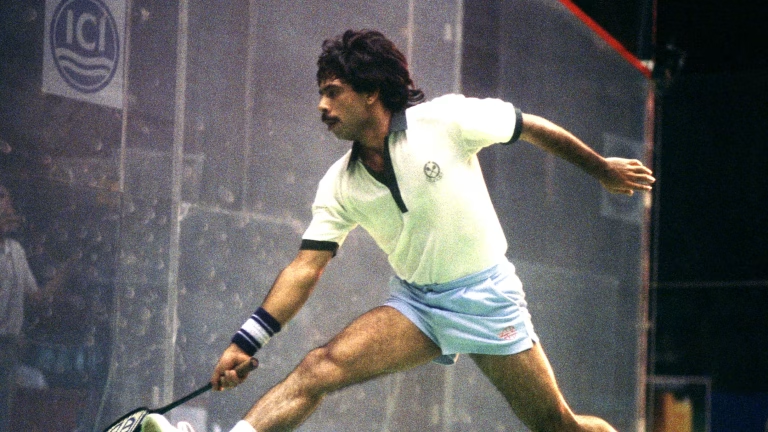
*Karachi, Pakistan – December 1996. The crowd at the Pakistan Open held its breath. A wiry, 6-foot-1 figure in white moved across the court with a grace that belied his predatory intent. The ball barely seemed to touch the walls before he was there—anticipating, intercepting, punishing. When the final point was won, the scoreboard told the story of a man who had just claimed his eighth World Open title. No one in the history of squash had ever done that. No one has since.*
The Lion Cub from Peshawar
Unlike his famous namesake Jahangir Khan (no relation), Jansher Khan was not born into squash royalty . His father was a storekeeper on the Pakistan Air Force payroll. Two older brothers, Mohibullah and Atlas, played the game, but there was no dynasty waiting to embrace him, no silver spoon carved from championship wood .
What Jansher had was something perhaps more valuable: raw, unpolished hunger.
Born on June 15, 1969, in Peshawar, Pakistan, Jansher—whose name means “Lion Hunter”—discovered squash late by champion standards . He started at age 11 in 1981, already playing catch-up to a generation of Pakistani greats who had dominated the sport for decades .
But the lion cub grew fast.
In 1986, at just 16 years old, Jansher Khan announced himself to the world. He traveled to Australia for the World Junior Squash Championships and returned as champion . The same year, he stunned the establishment by reaching the senior World Open final—and winning it, defeating Australia’s Chris Dittmar . At 16, he became the youngest winner in the history of the sport.
The squash world took notice. But the man who would become his greatest rival took something else: concern.
The Rivalry That Defined an Era
When Jansher emerged on the professional scene in late 1986, Jahangir Khan was considered invincible. The elder Khan had just completed his legendary 555-match winning streak and carried himself like a king who would never be dethroned .
Jansher didn’t care about reputations.
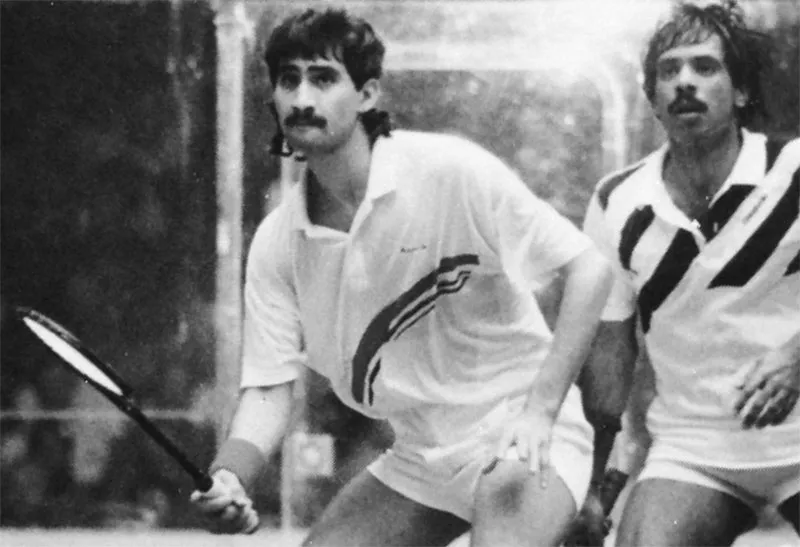
Their first few encounters went predictably—Jahangir won. But in September 1987, at the Hong Kong Open semi-final, the impossible happened. Jansher beat Jahangir in straight games . The squash establishment was stunned. A teenager from Peshawar had just beaten the Conqueror.
Then he did it again. And again. And again.
Jansher went on to defeat Jahangir in their next eight consecutive encounters . The head-to-head record between these two titans—36 tournament matches —tells a story of shifting power and mutual respect:
| Year | Matches | Jansher Wins | Jahangir Wins |
|---|---|---|---|
| 1986 | 1 | 0 | 1 |
| 1987 | 11 | 7 | 4 |
| 1988 | 8 | 3 | 5 |
| 1989 | 9 | 2 | 7 |
| 1990 | 5 | 5 | 0 |
| 1991 | 2 | 2 | 0 |
| Total | 36 | 19 | 17 |
Jansher edged the rivalry: 19 wins to Jahangir’s 17 .
Reflecting on those early breakthroughs, Jansher later said: “Beating Jahangir for the first time in Hong Kong was surprising for me. He was super fit, and to beat him for me was a dream. Jahangir had the name, the reputation, but I was not scared of playing him.”
The Punisher’s Toolkit
What made Jansher Khan so devastating? Contemporaries and analysts point to a unique combination of attributes:
1. Lightning Reflexes and Movement — Jansher possessed arguably the quickest hands and feet in squash history. His ability to retrieve seemingly winning shots and turn defence into attack was unparalleled .
2. Strategic Evolution — Unlike the power-based dominance of Jahangir, Jansher was a thinking player. He later reflected on how his game matured: “Before I just relied on fitness, but by ’93 my game had also developed and I did attack more with the drop, so I was a lot more comfortable going to the front and particularly with my backhand drop… I also had a pretty decent volley drop, and that allowed me to win some cheap points and break his rhythm.”
3. Tactical Slowing — Jansher’s game plan against the power-hitters was to play at a slower pace, relying on stamina and patience. As Jahangir himself acknowledged: “Jansher’s game plan was to play at a slower pace and rely more on a stamina strategy.”
4. Psychological Resilience — Jansher was unshakeable. He could absorb punishment, wait for opponents to tire or err, and then strike with surgical precision.
81: The Other Legendary Streak
While Jahangir’s 555-match streak is the most famous, Jansher’s own unbeaten run is remarkable in its own right. From 1990 until 1996, Jansher went 81 matches without defeat—a six-year stretch recognized by Guinness World Records as one of the longest winning streaks in top-level professional sports .
Eighty-one matches. Six years. Unbeaten.
That streak, combined with his eight World Open titles, forms the bedrock of his claim as squash’s greatest-ever champion.
Eight-Time World Champion: A Record That Stands Alone
The measure of Jansher Khan’s domination is most clearly evident in his eight World Open triumphs . Between 1987 and 1996, Jansher claimed the sport’s most prestigious title with staggering regularity:
World Open Finals (8 titles, 1 runner-up)
| Year | Location | Opponent | Score |
|---|---|---|---|
| 1987 | Birmingham, England | Chris Dittmar (Australia) | 9–5, 9–4, 4–9, 9–6 |
| 1988 | Amsterdam, Netherlands | Jahangir Khan (Pakistan) | 9-6, 9-2, 9-2 (Runner-up) |
| 1989 | Kuala Lumpur, Malaysia | Chris Dittmar (Australia) | 7–15, 6–15, 15–4, 15–11, 15–10 |
| 1990 | Toulouse, France | Chris Dittmar (Australia) | 15–8, 17–15, 13–15, 15–5 |
| 1992 | Johannesburg, South Africa | Chris Dittmar (Australia) | 15–11, 15–9, 10–15, 15–6 |
| 1993 | Karachi, Pakistan | Jahangir Khan (Pakistan) | 14–15, 15–9, 15–5, 15–5 |
| 1994 | Barcelona, Spain | Peter Marshall (England) | 10–15, 15–11, 15–8, 15–4 |
| 1995 | Nicosia, Cyprus | Del Harris (England) | 15–10, 17–14, 16–17, 15–8 |
| 1996 | Karachi, Pakistan | Rodney Eyles (Australia) | 15–13, 17–15, 11–15, 15–3 |
From 1992 to 1996, Jansher recorded five successive World Championship crowns—an unmatched run of dominance . When he won his eighth title in 1996, he surpassed Jahangir’s six and set a record that still stands today.
Poor Chris Dittmar—the Australian great who finished runner-up at the World Open four times (1987, 1989, 1990, 1992)—lost 17 finals to Jansher overall . For a generation of players, Jansher Khan was the immovable object at the summit of the sport.
Six British Opens and Complete Dominance
While Jahangir held a stranglehold on the British Open until 1991 (winning 10 consecutive titles), when he finally relinquished the crown, it was Jansher who seized it and refused to let go . From 1992 to 1997, Jansher won six consecutive British Open titles:
British Open Finals (6 titles, 3 runner-up)
| Year | Result | Opponent | Score |
|---|---|---|---|
| 1987 | Runner-up | Jahangir Khan | 9–6, 9–0, 9–5 |
| 1991 | Runner-up | Jahangir Khan | 2–9, 9–4, 9–4, 9–0 |
| 1992 | Winner | Chris Robertson | 9–7, 10–9, 9–5 |
| 1993 | Winner | Chris Dittmar | 9–6, 9–5, 6–9, 9–2 |
| 1994 | Winner | Brett Martin | 9–1, 9–0, 9–10, 9–1 |
| 1995 | Winner | Peter Marshall | 15–4, 15–4, 15–5 |
| 1996 | Winner | Rodney Eyles | 15–13, 15–8, 15–10 |
| 1997 | Winner | Peter Nicol | 17–15, 9–15, 15–12, 8–15, 15–8 |
| 1998 | Runner-up | Peter Nicol | 17–16, 15–4, 15–5 |
A Decade at Number One: 513 Weeks
Perhaps Jansher’s most stunning statistic is his longevity at the top. He was ranked World No. 1 from January 1988 until January 1998: 513 consecutive weeks—over 9.8 years at the summit of men’s professional squash .
That is the longest uninterrupted reign as world number one in the history of the sport. For nearly a decade, regardless of who came and went, Jansher Khan was the man everyone measured themselves against.
The Numbers Behind the Legend
Across his career, Jansher compiled statistical records that border on absurd:
| Statistic | Number |
|---|---|
| PSA Professional Matches Won | 293 out of 331 |
| PSA Professional Tour Finals Won | 99 out of 118 |
| Unbeaten Streak | 81 matches (1990-1996) |
| World No. 1 Ranking | 513 weeks (9.8 years) |
| World Open Titles | 8 (record) |
| British Open Titles | 6 |
| Hong Kong Open Titles | 8 (out of 9 finals) |
| World Super Series Finals | 4 (unbeaten in all) |
| Pakistan Open Titles | 6 |
| Head-to-Head vs. Jahangir Khan | 19-17 |
He won 99 major international titles in total .
To put it in perspective: Jahangir Khan won 134 PSA matches out of 164 and 61 finals out of 80. Jansher’s 293 wins and 99 finals represent a different level of sustained participation and excellence .
The Last Emperor
For nearly 50 years, from 1950 onwards, the Khan dynasty from the tiny village of Nawakille near Peshawar dominated world squash. They won 29 British Opens. When the World Open was initiated in 1975, they engraved their names on it repeatedly .
Jansher Khan was the sixth great champion to emerge from that lineage—and, as one observer put it, “the last Emperor” .
His retirement in 2001 brought an end to nearly five decades of Pakistani domination in the sport . The torch had been passed, extinguished, and no one from Pakistan has since recaptured the heights that the Khans once owned.
Injuries and the Price of Greatness
Jansher’s career was not without struggle. He was troubled throughout by back, knee, and groin injuries that would have ended lesser careers . In 2020, after suffering severe back pain while praying and walking, he underwent double back surgery in Peshawar .
Ever the warrior, his words after surgery were not for himself but for the next generation:
“I would advise today’s young players that along with their hard training they must take special care of their back, knee and groin injuries and treat minor ailments timely to avoid serious problems in future.”
In late 2011, Jansher was diagnosed with Parkinson’s disease—a cruel opponent for a man whose game was built on lightning reflexes and razor-sharp movement . Yet he has faced this challenge with the same resilience he showed on court.
Legacy and Recognition
The Government of Pakistan has honored Jansher Khan with its highest civilian awards :
| Award | Year |
|---|---|
| Pride of Performance | 1988 |
| Sitara-i-Imtiaz (Star of Excellence) | 1993 |
| Hilal-i-Imtiaz (Crescent of Excellence) | 1997 |
| Nishan-e-Imtiaz (Order of Excellence) | 2023 |
In 2020, he returned to the sport as Head Squash Coach for Khyber Pakhtunkhwa, determined to train the next generation of Pakistani champions .
Comparison: The Two Khans
The debate over who was greater—Jahangir or Jansher—remains one of squash’s great arguments:
| Achievement | Jahangir Khan | Jansher Khan |
|---|---|---|
| World Open Titles | 6 | 8 |
| British Open Titles | 10 | 6 |
| Consecutive World No. 1 | 94 months | 118 months |
| Longest Win Streak | 555 matches | 81 matches |
| Career PSA Wins | 134 | 293 |
| Head-to-Head Record | 17 wins | 19 wins |
Jahangir had the longer streak and more British Opens. Jansher had more World Championships, a longer reign at number one, and more career victories, and he won their personal rivalry.
As the PSA themselves noted: *”For many the fact that Jahangir, statistically holds the record of 16 major titles, six World Championships and a record 10 British Opens, while also racking up a mind-boggling 555 successive competitive victories, places him in an undisputed position as squash’s greatest of all time. Yet Jansher also has his distinct claims for pre-eminence having claimed a record eight World Championships and gone on to be the longest reigning World No.1, spanning almost 10 years while he also edged their 37-match head-to-head with 19 successes.”*
Perhaps the truest statement came from Jansher himself about what their rivalry meant: “Our rivalry was what drove me on, it made me train harder, made me fight longer and made me determined to keep improving my game because that is what I had to do to beat Jahangir.”
The Final Word
Jansher Khan—the Lion Hunter from Peshawar—did not inherit a throne. He conquered one. He faced the greatest player the sport had ever seen, defeated him more often than not, and then proceeded to build a record of championship excellence that has never been matched.
Eight World Opens. Six British Opens. Nearly a decade as world number one. Ninety-nine professional titles. An 81-match unbeaten streak. A 19-17 head-to-head edge over the man with 555 consecutive wins.
When he took his final bow, the curtain came down on five decades of Khan domination . It is unthinkable, unmatchable in any sport.
Jansher Khan was the last Emperor of Squash.
And Emperors, by definition, rule alone.
Key Sources: PSA World Tour official feature on the Khan rivalry ; Encyclopaedia Britannica biography ; Wikipedia career statistics ; Guinness World Records documentation ; SquashTalk profile